Two Employees, One Red Flag, Two Different Problems
Ask a CIO why a transformation stalled and you’ll usually hear about the technology first — the wrong platform, an integration that took longer than promised, a vendor that overpromised. Ask six months later, once the post-mortem is actually done, and the answer almost always changes.
The system works. People just aren’t using it the way it was designed.
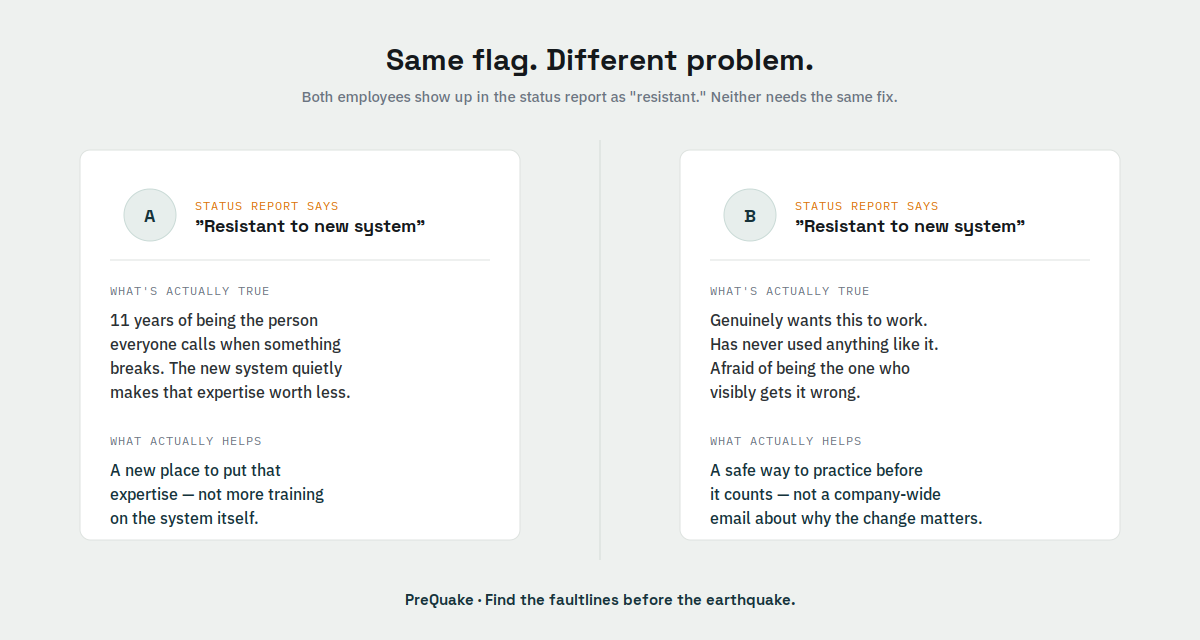
Two failure modes that look identical from the outside
Picture two employees, both flagged as “resistant” in a rollout status report. One has spent eleven years becoming the person everyone calls when something breaks — and the new system quietly makes that expertise worth less. The other genuinely wants this to work, but has never used anything like it and is afraid of being the one who visibly gets it wrong in front of their team.
Same label. Same status-report red flag. Completely different interventions required — one needs a new place to put their expertise, the other needs a safe way to practice before it counts. A rollout plan that treats both as “change-resistant, needs more communication” will fix neither.
This is the actual argument for structured interviews over a survey: a survey can tell you resistance exists. It generally can’t tell you which of these two people you’re looking at, and treating them the same wastes the exact intervention that would have worked.
The information usually arrives too late to matter
Most organizations do run a readiness check before a big rollout. The problem isn’t that they skip it — it’s when it happens. By the time a readiness survey goes out, training plans are usually finalized, the communication calendar is locked, and the launch date has already been defended to a steering committee. Whatever the survey finds, the room for genuinely changing course has mostly closed.
That timing turns a diagnostic into a formality — something that gets run because governance requires it, not because anyone expects it to change the plan. The organizations that actually avoid the expensive version of this failure run the diagnostic early enough that its findings can still move a decision, not just document one.
What middle management actually absorbs
There’s a specific pressure point that rarely makes it into a project charter: the manager caught between explaining a change they didn’t design, keeping their team’s output steady, and learning the new system themselves — often with less training time than the people they’re managing.
Employees tend to trust what their direct manager says over what arrives in a company-wide email. If that manager is themselves uncertain, that uncertainty doesn’t stay contained — it becomes the actual message the team receives, regardless of what the official communication said. A rollout plan that invests heavily in top-down messaging and lightly in equipping the manager layer is optimizing the wrong bottleneck.
The pattern underneath all three
Different symptoms, same root cause: organizations keep treating readiness as a single measurement taken at one point in time, by one method, from a sample of people, then acting as if that snapshot describes the whole workforce for the rest of the program.
None of the three problems above get fixed by running the same survey earlier or more often. They get fixed by asking better questions, of more people, closely enough to the decision that the answer can still change it — and by being specific enough about why someone is hesitant to actually do something about it, instead of filing it under a generic “resistance” line item.
That’s a different diagnostic altogether from what most transformation programs currently run. It’s also, not coincidentally, exactly the gap PreQuake was built to close.
See where your own organization stands.
PreQuake runs the same diagnostic thinking behind this piece — ten days, private structured interviews, two reports that change the steering-committee meeting.
Book a scoping call